The business plan. The marketing to make it happen.
A connected approach to brand growth
Your brand can run better. One connected growth plan.
Great marketing starts with the business behind it. Good Measure connects financial growth strategy, paid media, creative, and landing pages—so your revenue ambition, spending decisions, and team’s next moves belong to the same plan.
In good company · A few of the brands we work with
Strategy with follow-through
Four disciplines. One direction.
01 /
Financial growth strategy
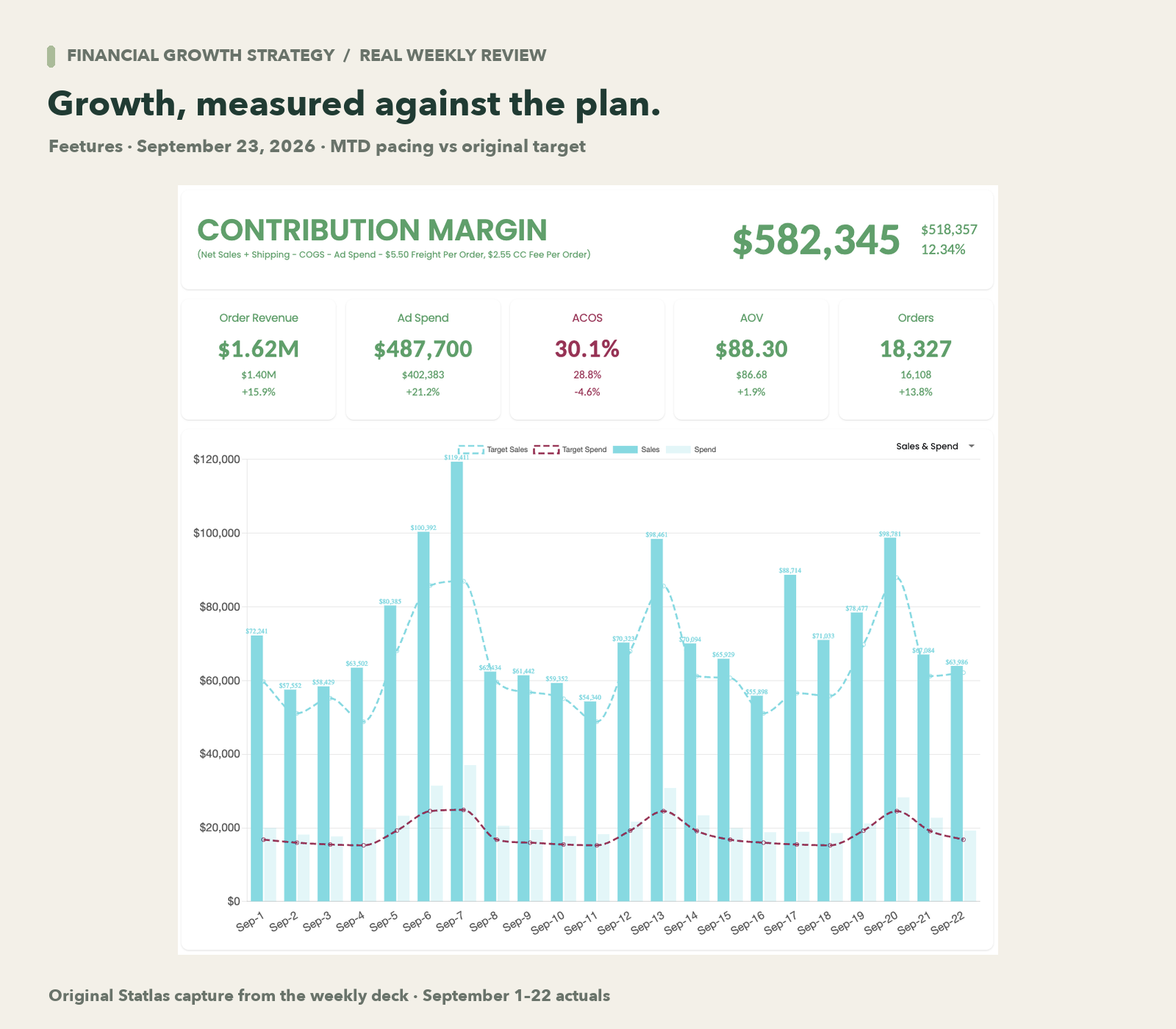
↗Feetures · September 23, 2026 review · actuals versus original target.
Build a forecast that explains where growth will come from: new customers, returning customers, product demand, and the spend required to support it. We connect revenue targets with contribution margin, cash goals, and inventory priorities. Forecast-versus-actual reviews reveal whether to adjust acquisition, promotion timing, purchasing, or expectations—not simply raise a revenue target.
You leave with: customer and demand forecasts, media budgets, sell-through priorities, and guidance on buy quantities and replenishment.
02 /
Paid media management
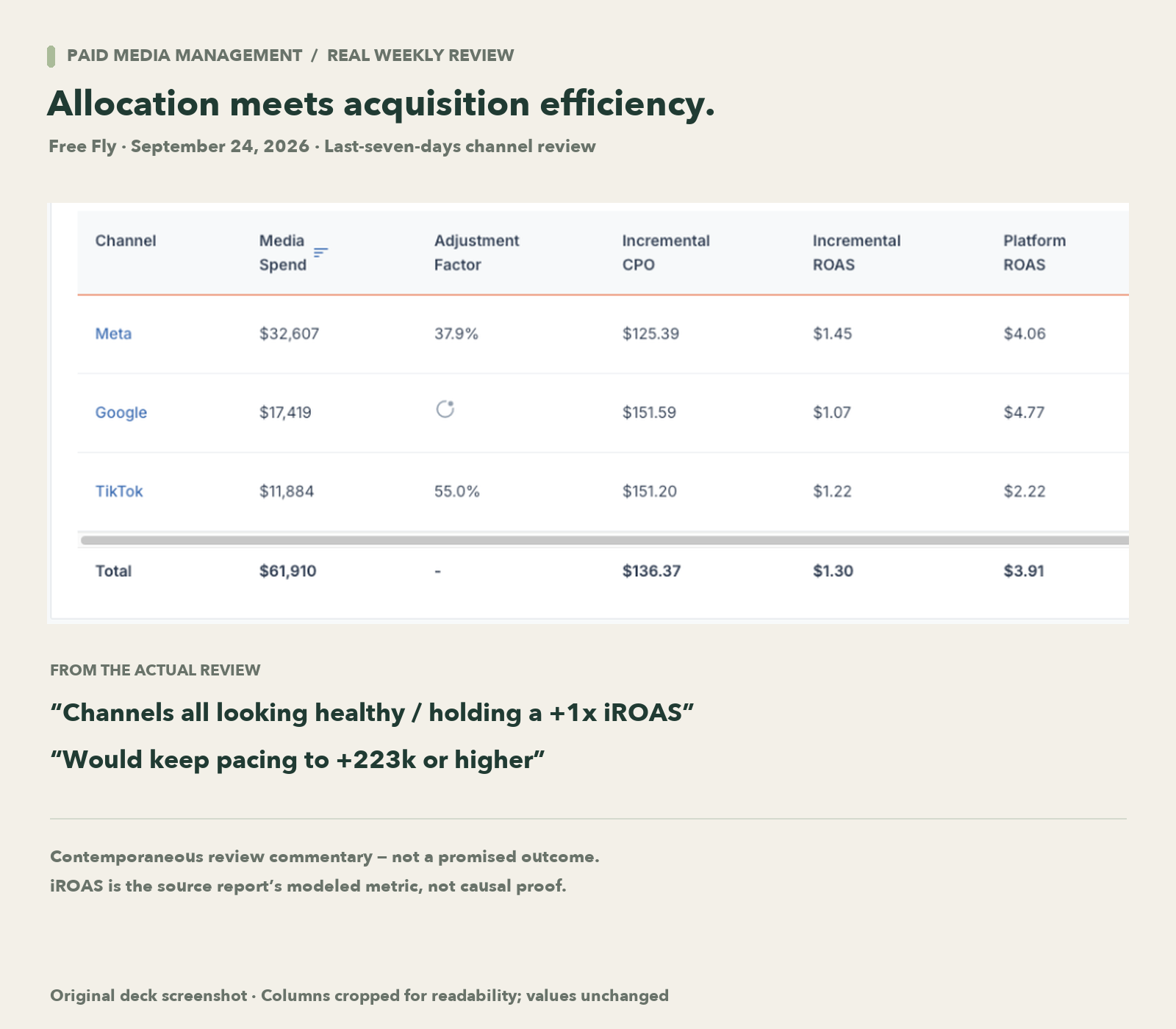
↗Free Fly · September 24, 2026 review · channel allocation and pacing discussion.
Turn the business plan into channel strategy, campaign setup, ad copy, creative coordination, and budget pacing. Across Meta, Google, and other relevant channels, we evaluate allocation against customer economics and product availability. The conversation moves beyond “what spent yesterday?” to what deserves investment, what needs a better test, and what should wait.
You leave with: a managed campaign plan, measurement priorities, ongoing optimization, and clear recommendations tied to the forecast.
03 /
Creative strategy
↗Selected client campaign creative · September 2026 · includes video stills.
Give production a commercial brief, not an open-ended request for more content. We connect customer motivations, product proof, performance patterns, and competitive observations to concepts, scripts, and format priorities. our Creative Planner brings creative demand and production status together, making the gaps visible before the next campaign needs to launch.
You leave with: audience-led hooks, production-ready briefs, a volume and format plan, and testing feedback for the next cycle.
04 /
Landing pages
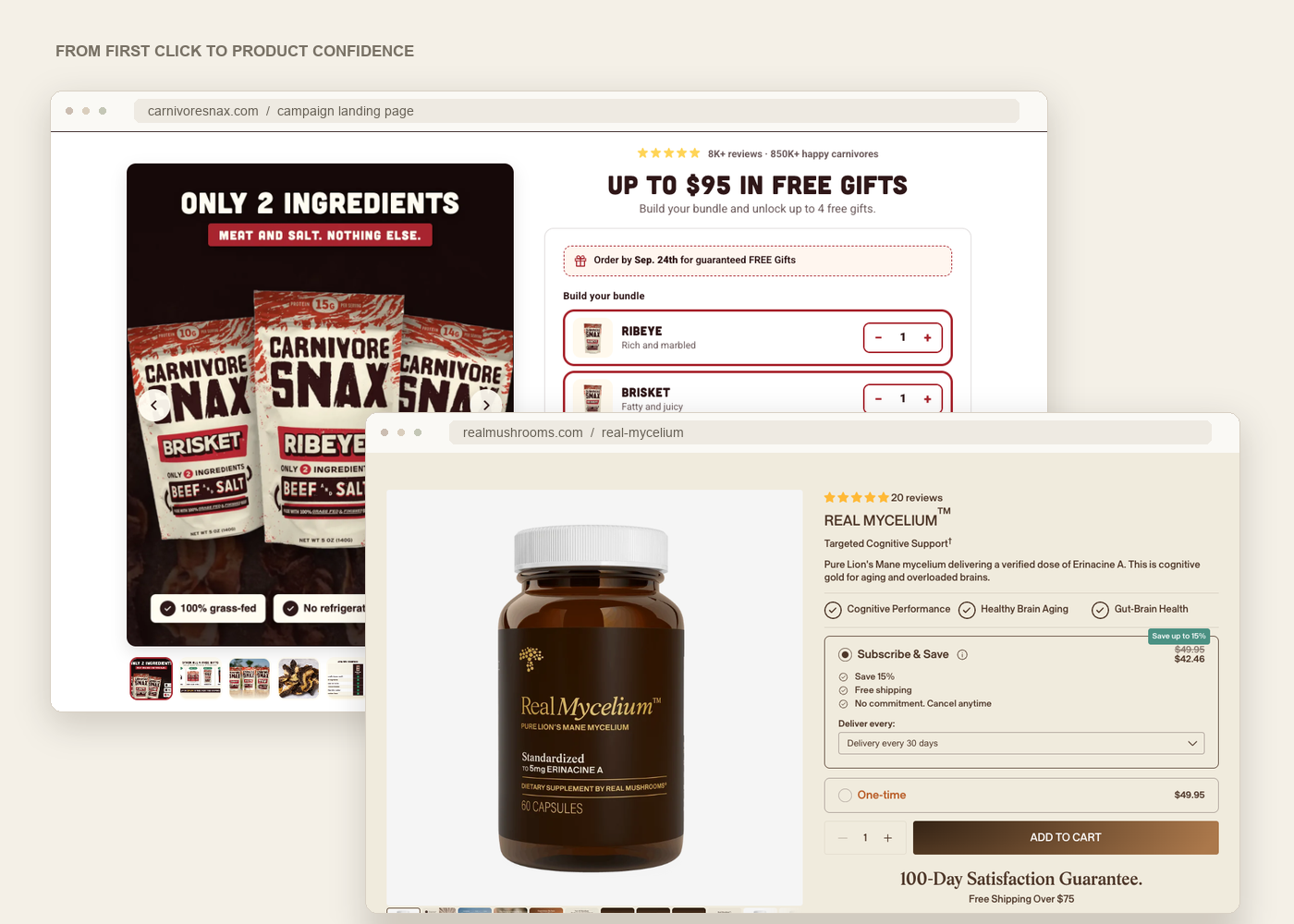
↗Client campaign destinations · ad-to-page continuity · captured September 24, 2026; offers may change.
Keep the promise made in the ad all the way through the page. We connect offer positioning, copywriting, design, and development around the customer’s next question: why this product, why this price, and why now? Conversion testing helps identify whether the page needs clearer proof, a better product explanation, or a more relevant offer.
You leave with: campaign-aligned pages and a prioritized iteration plan—not an isolated redesign disconnected from acquisition.
Our operating system
Statlas
Financial visibility. Shared accountability.
We use Statlas as the shared operating view for financial forecasts versus actuals, cohort economics, and channel pacing. New-customer acquisition and returning-customer behavior inform what the business can afford; inventory priorities inform what marketing should support. In weekly reviews, we turn the variance into decisions, owners, and next steps—keeping contribution margin at the center.
ForecastReview actualsChoose the next move
Our proprietary Creative Brain
Your next idea shouldn’t start from zero.
We’ve built a brand-specific creative intelligence system inside our Creative Planner. It brings your products, customer language, past creative, and market context into the same conversation—so our team can turn what we know into what you should test next.
The context
Brand voice & product truth
Customer reviews & motivations
Own-account creative & performance
Competitor references & prior ideas
✳
Creative Brain
Connect the evidence. Challenge the idea. Keep the useful learning.
The work
Evidence-backed creative directions
Hooks, concepts & test hypotheses
Structured briefs & production detail
Reviewable work & brand memory
01 / Understand
Keep the brand in the room.
Connect available product facts, customer tensions, approved guidance, and creative history. The context travels with the work instead of being rebuilt in every prompt.
02 / Recommend
Explain what to make—and why.
Develop hooks and concepts around a specific audience, product, and belief to change. Attach the evidence, uncertainty, and next test—not just a list of clever lines.
03 / Brief
Give the team a starting point.
Expand a direction into structured briefs with first frames, proof points, scripts, shot lists, and format guidance. Keep the idea connected to its references and production requirements.
04 / Remember
Carry the judgment forward.
Review prior ideas to reduce repetition. Save approved learning and feedback as brand memory that can inform the next round, rather than letting each review disappear into a chat.
Built to support judgment. Not bypass it.
Source checks and quality gates help surface weak evidence, missing assets, and ideas that need revision. Supported static-production workflows combine product references, generated visuals, and controlled brand overlays for review.
Capabilities depend on each brand’s connected sources and production readiness. Our team reviews strategy, product fidelity, claims, and final assets. Approval and media launch remain separate decisions.
our Creative Planner. From insight to what gets made.
A useful creative plan answers four questions: who are we trying to move, what must they believe, how much fresh work do we need, and what can we afford? Below, see the actual app interfaces: rewritten supplement-brand audiences and strategy examples, a real client planning snapshot, and an illustrative creative P&L. Each visual identifies its data basis.
01 / Give every concept a customer.
Actual app components · fictional supplement brand
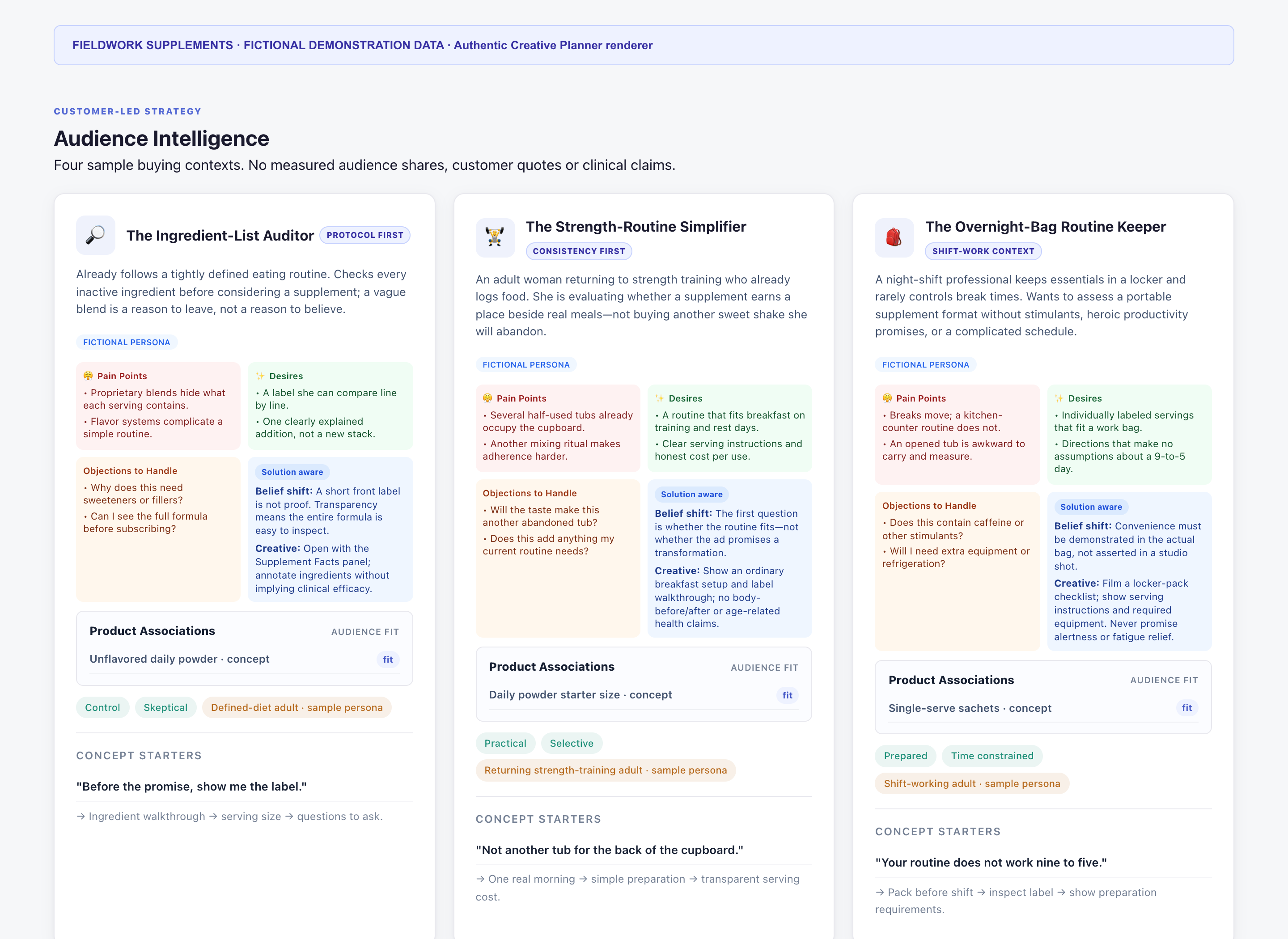
An audience is more useful than a demographic label. The planner connects buying context, frustrations, objections, product fit, and the belief an ad needs to change. Here, the ingredient-list auditor, strength-routine simplifier, and overnight-bag routine keeper need different reasons to consider the same brand.
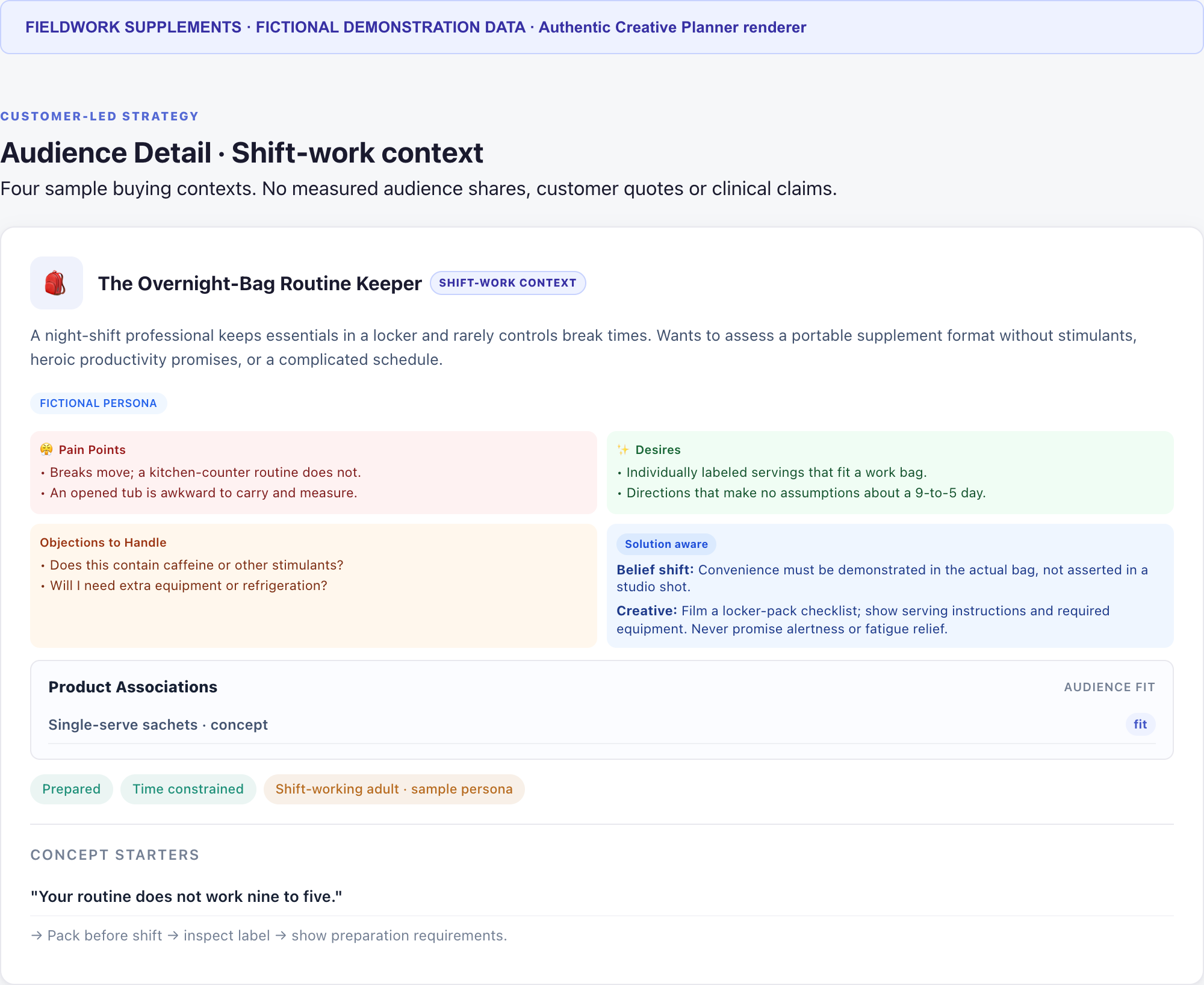
Actual audience-card components, populated with rewritten demonstration content for Fieldwork Supplements. No measured audience shares or customer quotations. Open full-size ↗Explore one audience: the shift-work routineFrom a practical tension—unpredictable breaks—to a demonstrable creative idea: show what fits in the work bag and how it is used. Open full-size ↗
The output is a briefable direction: who it is for, which objection to answer, what product proof to show, and where the concept starts. Sample copy is not a verified product claim.
02 / Connect the media plan to the production plan.
Actual app interface · October 2026 client plan
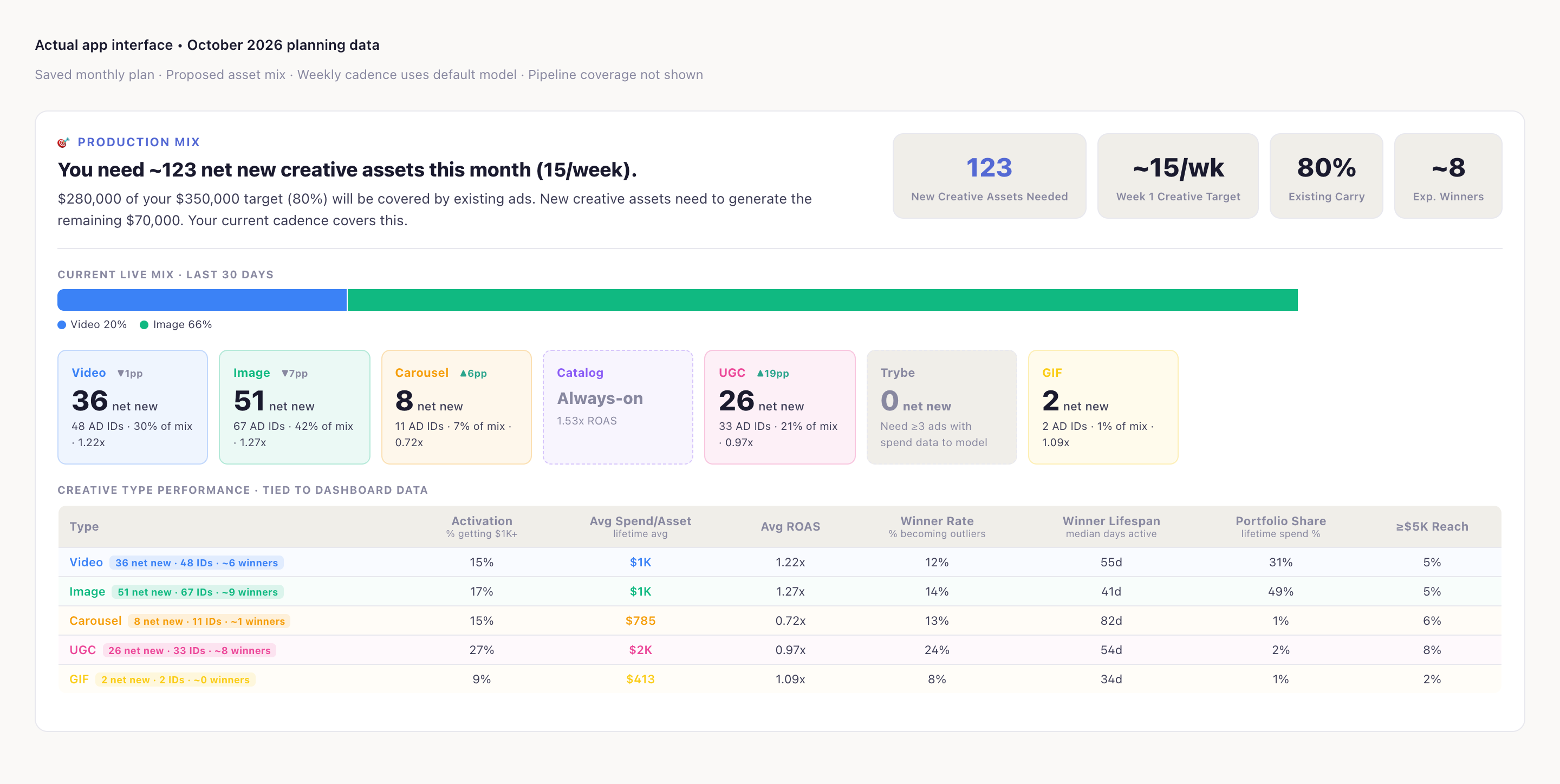
Start with the budget, account for what existing ads can carry, then size the new work. This real planning snapshot has a $350,000 media target: $280,000 modeled carryover and a $70,000 gap. The saved plan calls for 123 net-new creative assets and 161 ad IDs—separate units, because producing an asset is not the same as launching every variation.
Current production components, rendered locally with a real October 2026 client plan. Format allocations are recommendations, not approved production orders. Open full-size ↗
The proposed mix includes 36 videos, 51 images, 8 carousels, 26 UGC assets, and 2 GIFs. The app retains its legacy UGC classification. Weekly cadence uses the default model; pipeline coverage is not shown. The live-mix bar omits Catalog, so its displayed percentages do not total 100%.
03 / Turn market context into a creative decision.
Actual report interface · illustrative content
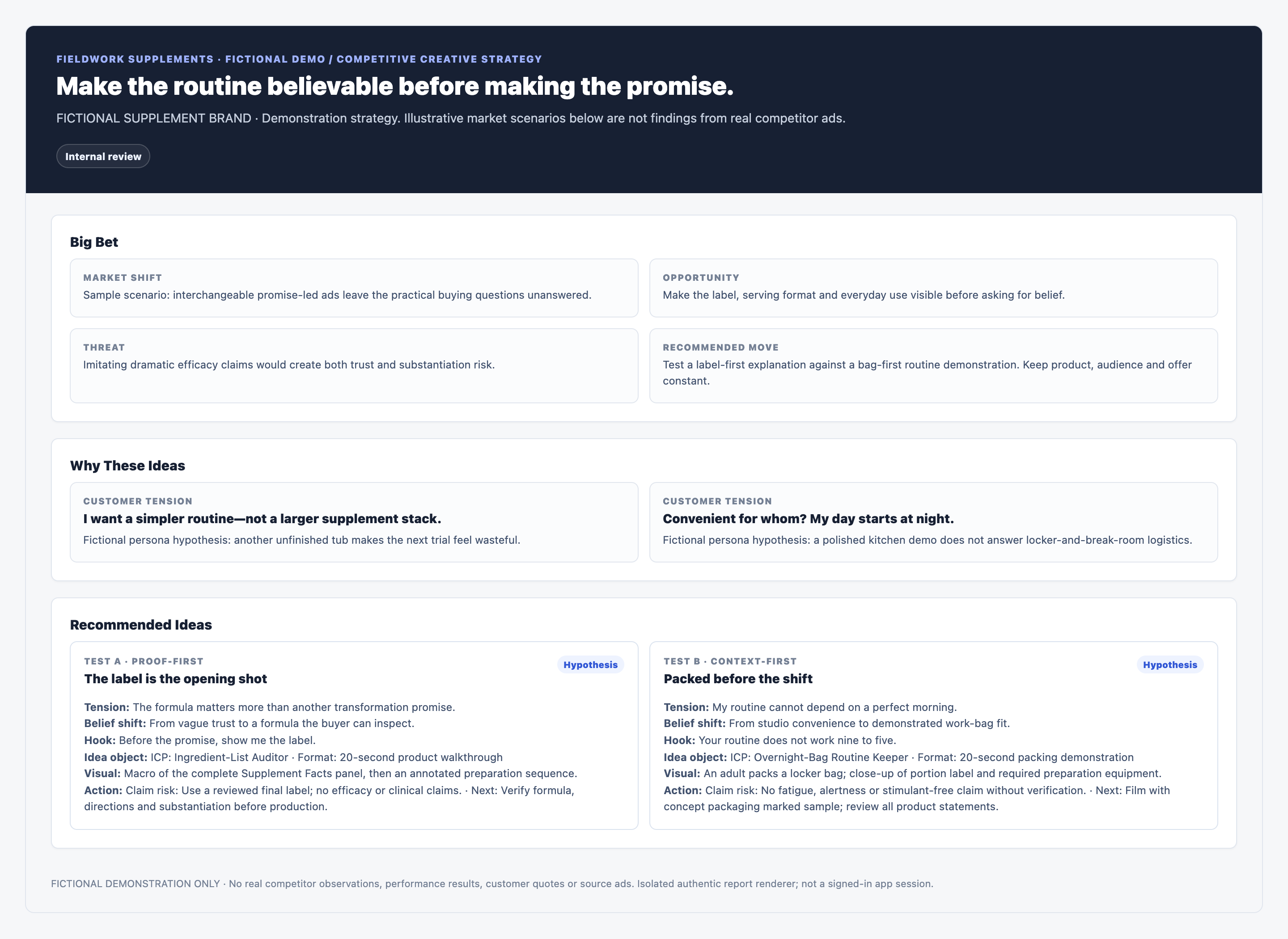
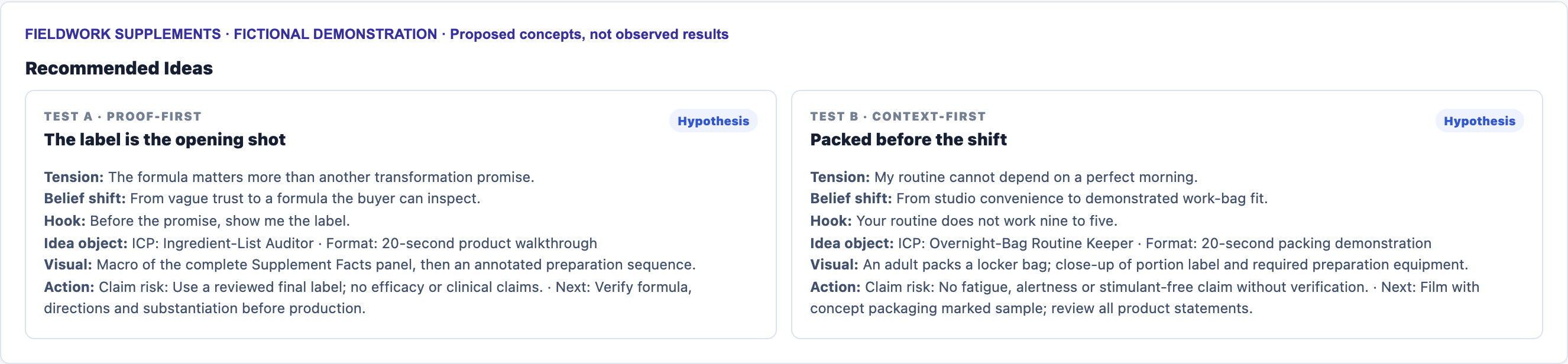
Competitor reporting should end with a recommendation, not another folder of saved ads. The app organizes a strategic thesis, customer tensions, and specific tests—connecting what the team sees in the market to what it should make next. This supplement-brand demonstration shows how that reasoning becomes two distinct creative approaches.
Authentic report renderer with fictional market scenarios—not observed competitor findings, performance results, or a signed-in app capture. Open full-size ↗Read the recommended creative testsEach idea connects an audience, a hook, a visible execution, and a production next step. Test one meaningful change rather than copying a competitor’s ad. Open full-size ↗
Live research is grounded in available source ads and observation dates. An ad’s activity or longevity does not establish performance; the actionable output is a test hypothesis for your brand.
04 / Put creative inside the economics.
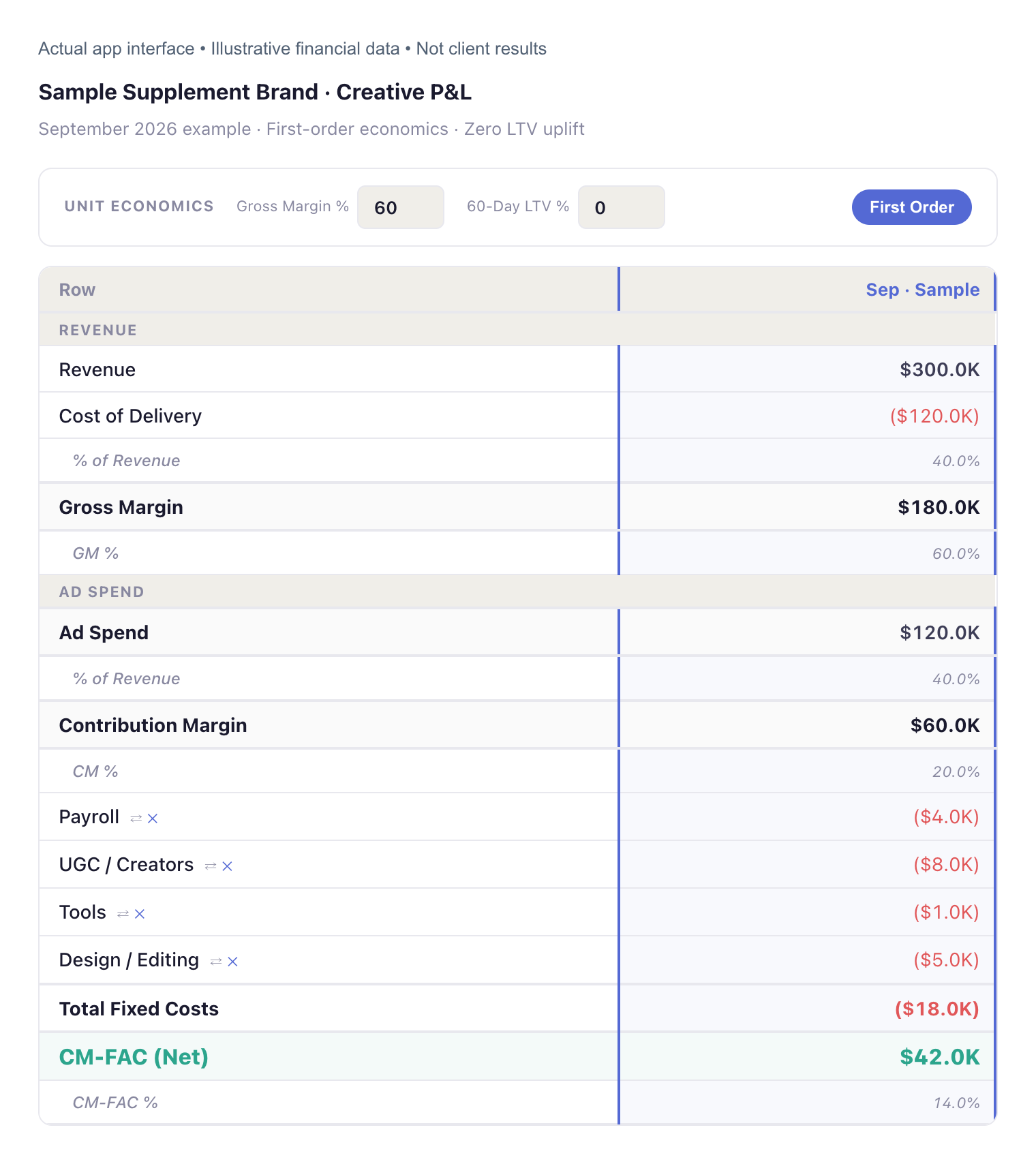
Actual P&L interface · illustrative financials
Media ROAS alone leaves out the cost of making the ads. The app brings payroll allocation, creators, tools, and design into the same financial view as revenue, delivery costs, and ad spend. This separate sample month shows $300,000 in revenue becoming $60,000 in contribution after delivery and advertising, then $42,000 after $18,000 in creative costs.
Actual financial-table renderer, focused on one illustrative month. Sample data—not Feetures financial results. First-order economics with zero LTV uplift. Open full-size ↗
Creative OPEX in this example is $8,000 for creators, $5,000 for design/editing, $4,000 allocated payroll, and $1,000 for tools. The resulting 14% contribution is not company net profit; other overhead and taxes are excluded. Platform-attributed revenue is not proof of incremental sales.
A practical working rhythm
Less disconnect. More direction.
We start with your goals, economics, inventory position, and marketing calendar. Then we connect the forecast to channel budgets, creative briefs, and page priorities. Slack keeps the work moving; weekly reviews compare the plan with reality, assign owners, and decide what changes next. Bring the decisions on your plate. Let’s talk through a connected plan.